The Signal is dead
Technical screening today runs through HackerRank, CodeSignal, and tests built in their image: data structures, algorithms, timed puzzle questions. That signal is going obsolete.
Programming is becoming agentic. Good engineers ship serious work without hand-writing most of if not all their code. Ranking candidates by how well they invert a binary tree under a timer tells you less every month.
The way we interview people needs to change as systematically as the way we write software already has.
Real tasks, real codebases, real agents
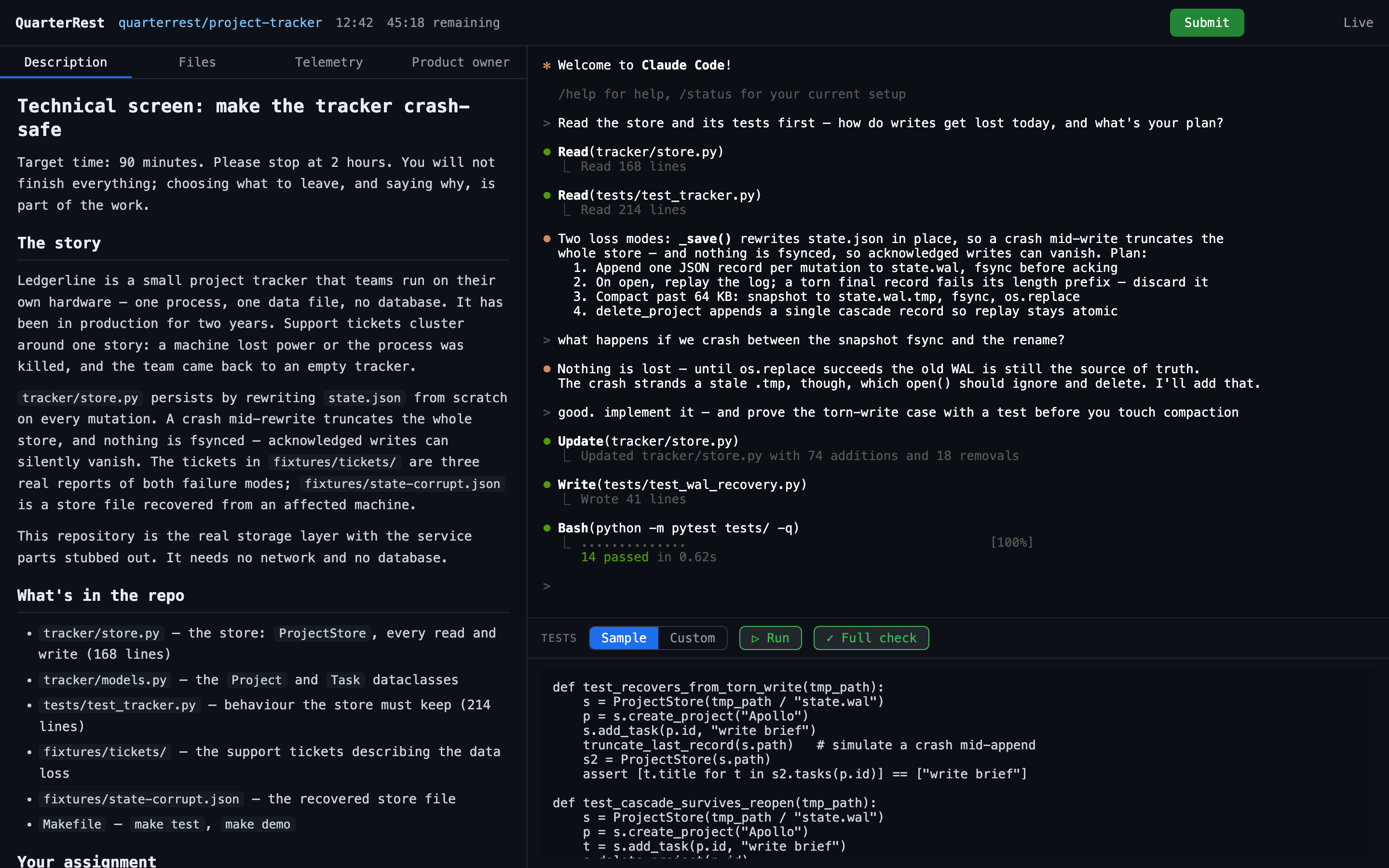
QuarterRest is an interview and assessment suite that evaluates how candidates use agentic coding tools. Claude Code, Codex, Cursor, or any model supported through opencode.
We put candidates into a complicated scenario: a code migration, a feature request, a research task. They use the tools they'd actually use on the job, on the kind of work they'd realistically see there too.
How an interview runs
- 1
You pick a scenario from our library, or bring a task and rubric of your own.
- 2
The candidate opens a link and lands in a live environment with the codebase and their agent.
- 3
They work. The full session is captured: every prompt, edit, question, and check.
- 4
You get a report on whether the work got done and how they got there, with links to the exact moments behind every score.
Nothing to install, nothing to configure
Claude Code, Codex, and the rest of the agentic toolchain normally live in a terminal on somebody's machine. QuarterRest is cloud-hosted and runs entirely in the browser: the repository, the agent, and the clock, all in one tab, behind one link.
Every session is provisioned fresh from the same image and stamped with a reproducibility record — the environment, the agent and its version, the model. No setup drift, no local quirks; every candidate plays the same instrument, so runs can honestly be compared.
Grading that looks past “done”
With agents in the loop, completing the task is not a hard bar anymore. Most candidates will get something working. The difference between great candidates and the rest lives in their design decisions, their workflow, and the questions they ask. That's what our grader focuses on.
Companies can also write custom rubrics to screen for exactly the style of engineer they want. It makes the whole process more intimate than a leaderboard. A non-traditional candidate with no famous logos on their resume still stands out when they build the way your team builds.
Nobody should lose an offer to unfamiliar tooling
We keep a large suite of practice problems so people can get familiar with agentic coding before it counts: what working with these tools actually looks like day to day, and how these interviews are structured.
Run it on your own task
The fastest way to judge QuarterRest is to watch it grade a task from your real backlog.
Book a demo